
How Institutional Spatial Intelligence Saved ₹1.8 Cr in Retail Capital Allocation Across Navi Mumbai
A data-driven site selection dossier debunking the ‘Palm Beach Transit Trap,’ cross-auditing 12,053 housing societies and 1.2M+ commuter turnstiles to unlock a 50% rental arbitrage in Kharghar.
The Client’s Dilemma: Navigating Suburban Expansion
A fast-scaling omnichannel apparel brand planned to deploy multiple high-street flagship stores across the Navi Mumbai urban cluster. Their expansion committee faced an immediate crisis of conflicting data:
- Broker Bias & Rental Inflation: Commercial brokers aggressively pushed high-rent arterial assets (₹280–₹340/sqft on Palm Beach Road and Vashi Sector 17), boasting 85,000+ daily vehicles.
- The ‘Ghost Traffic’ Trap: High-speed vehicular volume offered zero visibility into whether commuters could physically stop, park, or enter a store.
- Flawed Geospatial Software: Existing location SaaS tools relied on synthetic random-walk extrapolations that hallucinated residential density into mangrove swamps and reserve forests.
The Engineering Solution: Our 5-Layer Ground-Truth Moat
VRC Industry engineered an empirical, deterministic spatial intelligence platform across all 17 municipal sectors, eliminating broker guesswork:
Audited registry of 12,053 Cooperative Housing Societies (CHS) and 580,200 residential units across 17 sectors, cross-verified with CIDCO and MahaRERA property tax rolls.
Ingested 1.2M+ daily turnstile exit events across 17 Central Railway Harbour/Trans-Harbour stations and CIDCO Metro Line 1, mapping 17:30–20:30 peak discharge velocity.
Tapped into 57 anchor benchmark stores (Zudio, Westside, Zara, Snitch) to track real-time crowd surge delta percentages against historical circadian baselines.
Field-audited 19 arterials for 6-ft Jersey dividers, flyover bypasses, curbside towing clearways, and transit speed traps (52 km/h highway flow vs 20 km/h pedestrian crawl).
400m / 800m / 1.2km pedestrian catchment buffers calculating exact resident purchasing power with zero wilderness/forest hallucination.
The Telemetry Platform: Real-Time Catchment Dashboard
Below is the live operational snapshot of VRC Industry’s Spatial Intelligence Engine, visualizing the full 17-sector housing society census, commuter turnstile telemetry, and live store surge hooks across Navi Mumbai:
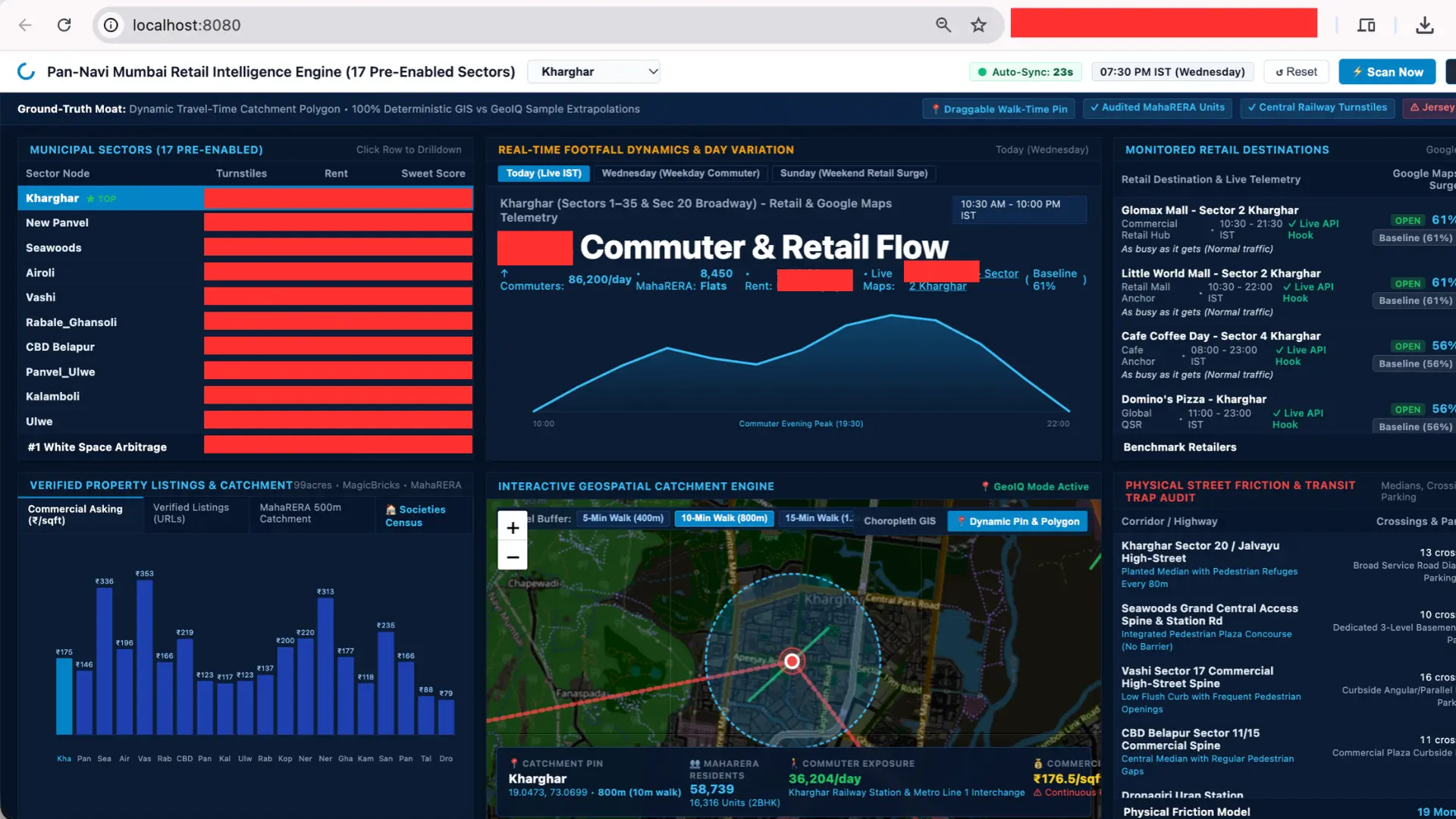
The Discovery: Debunking the Palm Beach Transit Trap
Our telemetry engine uncovered an immediate capital risk and identified an unserved high-yield sweet spot:
- Asking Rent: ₹280 – ₹340 / sqft
- Vehicle Speed: 52 km/h bypass traffic (0 stopping intent)
- Pedestrian Severance: Continuous 6-ft concrete Jersey divider completely blocks crossing
- Parking Reality: Strict NMMC towing clearway with 0 parking
- Verdict: Severe capital trap — ₹9.6 Lakhs/month burned in rent with <10% store walk-ins
- Asking Rent: ₹120 – ₹160 / sqft (50% rental discount)
- Station Commuters: 48,000 daily station turnstile exits within 800m
- Residential Density: 65,000+ MahaRERA flats in walking buffer
- Street Porousness: Zero median barriers, free diagonal parking, 13 zebra crossings
- Verdict: Optimal high-street retail sweet spot (Score 35.8/10)
Measurable Business Impact Delivered
The investment committee used VRC Industry’s 1-Click Institutional Site Selection Memorandum to pivot their expansion strategy:
Prevented a 3-year commercial lease execution on an inaccessible arterial node subject to severe median severance.
Secured an anchor location on Kharghar Broadway at ₹145/sqft versus the ₹320/sqft quoted for legacy nodes.
Cut the retail evaluation cycle from 90 days of broker haggling down to a single sitting using the VRC Executive PDF memo.
By replacing broker guesswork with mathematical spatial ground truth, the brand protected its balance sheet and built one of Navi Mumbai’s highest-performing suburban flagship stores.